

Thin Client Market Forecast Highlights a Strong 8.5% CAGR Growth Trend During 2025–2035
Thin Client market
Thin Client Market Size, Share and Research Report: By Deployment Type (On-Premises, Cloud-Based, Hybrid), By End Use Industry (Education, Healthcare)
Thin Client Market is gaining momentum as organizations prioritize secure, centralized, and cost-effective computing solutions for modern workplaces.”
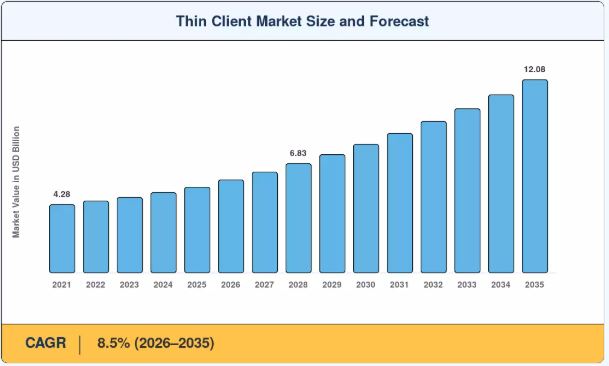
TAIPEI, TAIPEI, TAIWAN, June 29, 2026 /EINPresswire.com/ -- The Global Thin Client market was valued at USD 5.35 billion in 2025 and is projected to expand from USD 5.80 billion in 2026 to USD 12.08 billion by 2035, registering a CAGR of 8.5% during the forecast period. Thin clients lightweight computing terminals that stream virtual desktop sessions from centralized servers or public cloud platforms rather than processing workloads locally are becoming the endpoint of choice for security-conscious enterprises, government agencies, and regulated-industry organizations that demand centrally managed, auditable computing environments. — Market Research Future (MRFR)
Federal Executive Order 14028 and the Cybersecurity and Infrastructure Security Agency’s zero-trust maturity model have accelerated secure endpoint procurement across US government agencies and their private-sector supply chains, while global virtual desktop infrastructure investment surpassing USD 9 billion in 2024 is validating the architectural shift underpinning thin client market growth.
Two structural catalysts are converging to sustain the thin client market’s decade-long growth trajectory: the imperative of zero-trust endpoint security compliance in an era of escalating cyber-insurance premiums and regulatory mandates, and the powerful total-cost-of-ownership advantage of centrally managed thin terminals over distributed fat-client desktop estates. Enterprises reallocating IT budgets under rising cyber-insurance costs find centrally managed thin client endpoints a pragmatic path to compliance and cost control simultaneously.
Thin client terminals draw a fraction of the power of conventional desktop PCs, and the US Department of Energy Federal Energy Management Program’s ENERGY STAR Thin Client Specification capping idle power consumption at minimal baseline wattages is aligning energy efficiency with procurement mandates across institutional buyers globally.
Get Full PDF Sample Copy of Report: (Including Full TOC, List of Tables & Figures, Chart) @
https://www.marketresearchfuture.com/sample_request/12341
➤ How Significant Is the Thin Client Market’s Growth?
The thin client market’s trajectory from USD 5.35 billion in 2025 to a projected USD 12.08 billion by 2035 represents more than a doubling over the forecast decade, reflecting the structural and durable shift of enterprise endpoint strategy away from distributed fat-client desktops toward centrally provisioned virtual desktop thin client architectures that deliver superior security control, lower total cost of ownership, and significantly reduced energy consumption.
Hardware commanded 57.6% of thin client market revenue in 2025, reflecting persistent demand for purpose-built endpoint terminals across enterprise and government estates, while software and services are forecast to grow at a faster 9.0% CAGR through 2035, fueled by subscription-based endpoint management platforms and managed desktop-as-a-service offerings.
IT and telecom held the largest end-user industry share at 26.5% in 2025, led by service-provider network operations centers and high-density call-center deployments where centralized management and rapid session provisioning deliver significant operational advantages. Healthcare is advancing at the fastest vertical CAGR of 9.8% through 2035, driven by HIPAA-compliant workstation mandates, electronic health record modernization programs, and the clinical requirement for secure, shared-access endpoints at hospital nursing stations and physician workspaces.
➤ What Does the Future Hold for the Thin Client Market?
Zero-trust security mandates are the single most powerful near-term demand catalyst for the thin client market, contributing 18–22% to the CAGR. The CISA Zero Trust Maturity Model requires federal civilian agencies to enforce device-identity verification across all networks, compelling organizations to transition from unmanaged legacy PCs toward centrally provisioned thin terminals whose firmware, operating systems, and session policies can be audited continuously in real time.
This compliance-driven procurement wave is extending from federal agencies into state and local government, defense contractor supply chains, and regulated financial services firms that carry cyber-insurance policies with explicit endpoint security requirements collectively representing a vast addressable market for secure thin client endpoint solutions.
Hybrid and remote work expansion has permanently elevated the strategic priority of virtual desktop thin client infrastructure within enterprise IT planning. The normalization of distributed workforce models across knowledge-worker roles has created sustained demand for enterprise thin client solutions that deliver consistent, IT-managed computing environments regardless of employee location.
Cloud-native VDI platforms from Microsoft (Azure Virtual Desktop), Citrix, and VMware accessed through thin terminals rather than unmanaged personal devices enable enterprises to apply consistent security policies, data loss prevention controls, and application governance across remote workforces, establishing VDI and thin client hardware as complementary investments within enterprise secure access architecture programs.
Device-as-a-Service business models are reshaping the thin client market’s commercial structure, lowering adoption barriers for mid-market and public sector buyers while creating new recurring revenue streams for hardware OEMs. Rather than capital-purchasing thin client terminals on multi-year refresh cycles, enterprises are increasingly subscribing to bundled hardware, firmware management, remote monitoring, and replacement services that convert endpoint infrastructure into a predictable per-seat monthly operating expense.
This DaaS model expansion offered by Dell Technologies, HP Inc., and Lenovo in particular is extending thin client market access to organizations that previously deferred centralized computing migrations due to upfront capital constraints, while simultaneously improving vendor revenue visibility and deepening customer relationships.
➤ Who Are the Key Players in the Thin Client Market?
The thin client market is served by major enterprise hardware OEMs with broad product portfolios alongside specialized thin client and endpoint management software vendors that target security-driven enterprise and government buyers. MRFR identifies the following key participants:
Dell Technologies Inc. a global leader in enterprise endpoint hardware, providing the Wyse thin client terminal line alongside its cloud-managed endpoint management platform, serving enterprise, healthcare, government, and education customers with a broad portfolio ranging from entry-level shared-access thin clients to high-performance unified communications-capable terminals.
HP Inc. a major thin client hardware provider offering the t-series and mt-series thin client and mobile thin client platforms, with a growing managed services capability and Device-as-a-Service offering that bundles hardware, support, and lifecycle management into per-seat subscription models for enterprise customers.
IGEL Technology GmbH a specialist in thin client operating system and endpoint management software, providing the IGEL OS Linux-based endpoint platform and IGEL Management Suite that enable any x86 hardware to be converted into a centrally managed, secure thin client endpoint, with particular strength in healthcare and financial services verticals.
Lenovo Group Limited a major global PC and thin client hardware manufacturer providing ThinkCentre tiny-class and purpose-built thin client terminals alongside its Device-as-a-Service and PC-as-a-Service managed endpoint offerings for enterprise and government procurement programs.
Cisco Systems, Inc. a networking and collaboration technology leader providing thin client-compatible virtual desktop infrastructure components including Cisco Unified Communications thin client integration, Webex virtual desktop optimization, and secure remote access infrastructure that underpins enterprise thin client deployments.
NComputing Co., Ltd. a specialist thin client and virtual desktop technology provider focused on cost-effective shared-computing solutions for education, small and mid-sized enterprise, and developing-market deployments, offering hardware thin clients and software-defined desktop virtualization platforms.
Fujitsu Limited a Japanese IT services and hardware company providing FUTRO-series thin client terminals and managed endpoint lifecycle services for enterprise and government customers, with particular strength in European markets and integrated BIOS security capabilities for zero-trust endpoint compliance programs.
10ZiG Technology Ltd. a specialist thin client hardware and software vendor providing secure, centrally managed thin terminals optimized for VMware Horizon, Citrix Virtual Apps and Desktops, and Microsoft Azure Virtual Desktop environments, targeting security-sensitive enterprise and government endpoint refresh programs.
Competitive dynamics in the thin client market are increasingly shaped by the depth of zero-trust security feature integration including hardware root-of-trust, secure boot, and firmware attestation capabilities alongside the strength of managed endpoint software ecosystems and the appeal of Device-as-a-Service commercial models that convert hardware procurement into recurring subscription relationships.
➤ What Are the Emerging Trends in the Thin Client Market?
Several transformational trends are redefining the thin client market’s evolution through 2035:
Zero-Trust Security Mandates Driving Secure Endpoint Procurement: CISA’s Zero Trust Maturity Model and Federal Executive Order 14028 are compelling US government agencies and regulated private-sector organizations to replace unmanaged fat-client PCs with centrally provisioned, continuously auditable thin client terminals, establishing a durable compliance-driven demand floor that is extending into state government, defense contractor supply chains, and cyber-insurance-mandated enterprise endpoint programs.
Cloud VDI & Desktop-as-a-Service Platform Growth: Global investment in virtual desktop infrastructure surpassing USD 9 billion in 2024 is validating the architectural shift toward server-side computing that underpins thin client hardware demand. Microsoft Azure Virtual Desktop, Citrix DaaS, and VMware Horizon cloud editions are driving enterprise VDI adoption that generates predictable, sustained thin client endpoint hardware replacement cycles.
Device-as-a-Service Commercial Model Expansion: Dell Technologies, HP Inc., and Lenovo are converting thin client hardware procurement into per-seat managed subscription services that bundle hardware, firmware management, remote monitoring, and lifecycle replacement, lowering the capital barrier for mid-market and public sector thin client adoption while generating predictable recurring revenue for OEMs.
Healthcare Digital Workspace Modernization: HIPAA-compliant shared-access workstations, electronic health record platform optimization, and hospital network security upgrade programs are driving thin client adoption across clinical environments at a 9.8% CAGR the fastest among all end-user verticals as healthcare IT leaders prioritize the data security and centralized management advantages of thin client endpoints over unmanaged PC estates.
Energy Efficiency & Scope-2 Carbon Reporting Requirements: EU Cyber Resilience Act obligations, scope-2 carbon reporting mandates for large enterprises, and the US ENERGY STAR Thin Client Specification are accelerating corporate procurement preference toward low-power thin terminals that consume a fraction of conventional desktop PC energy, aligning sustainability targets with IT security modernization objectives.
Edge Computing Integration: The deployment of thin client terminals as managed access points for edge computing environments processing structured query results and streaming analysis outputs from edge servers rather than performing compute locally is creating a new application category that extends the thin client model beyond traditional VDI into industrial IoT monitoring, retail analytics, and smart building management access scenarios.
Get access to the full description of the report @
https://www.marketresearchfuture.com/reports/thin-client-market-12341
➤ How Is the Thin Client Market Segmented?
The thin client market report provides a comprehensive segmentation framework:
By Deployment Type: On-Premises, Cloud-Based, Hybrid
By End Use Industry: Education, Healthcare, Manufacturing, Retail, IT & Telecom, BFSI, Government
By Operating System: Windows, Linux, Chrome OS
By Component: Hardware, Software, Services
By Region: North America, Europe, Asia-Pacific, South America, Middle East and Africa
➤ What Are the Regional Insights from the Thin Client Market?
North America generated 34.0% of global thin client market revenue in 2025, supported by federal zero-trust procurement timelines, corporate IT security refresh cycles driven by rising cyber-insurance premiums, and the region’s deep base of healthcare, financial services, and government organizations with stringent endpoint security and data governance requirements. The US government’s CISA Zero Trust Maturity Model implementation timeline is compelling federal civilian agencies and their contractor ecosystems to accelerate thin client adoption, while state and local government digital transformation programs funded through the Infrastructure Investment and Jobs Act are adding incremental public-sector demand.
Europe holds the second-largest regional share at approximately 28%, driven by EU Cyber Resilience Act endpoint security obligations, scope-2 carbon reporting requirements that favor low-power thin terminals over energy-intensive PC estates, and strong enterprise VDI adoption across Germany, the United Kingdom, France, and the Nordic countries. European public-sector organizations including national health services, financial regulators, and government ministries with classified data handling requirements represent a particularly active procurement segment for certified, security-hardened thin client endpoint solutions from Fujitsu, HP Inc., and IGEL Technology.
Asia-Pacific exhibits the fastest regional trajectory at a 9.5% CAGR through 2035, with India’s Digital India program and China’s enterprise cloud adoption push as the primary catalysts. India’s government digitalization mandate is funding large-scale thin client deployments across government offices, public health facilities, and educational institutions as a cost-effective alternative to individual PC procurement. China’s enterprise cloud workspace expansion is driving corporate thin client adoption across financial services, telecommunications, and manufacturing sectors. Southeast Asian government digitalization investments in Thailand, Indonesia, and Vietnam are also contributing to the region’s above-average growth trajectory.
South America and the Middle East & Africa represent emerging growth markets for thin client technology, with adoption driven by government e-governance programs, educational institution computing infrastructure investments, and the total-cost-of-ownership advantage of thin clients over PC estates in budget-constrained institutional environments. Brazil’s government digital transformation program, Saudi Arabia’s Vision 2030 public-sector digitalization initiative, and Africa’s expanding mobile and cloud infrastructure are collectively establishing the foundational connectivity and cloud platform prerequisites for thin client market growth across these regions through 2035.
➤➤➤ Regional & Country-Level Reports by Market Research Future:
Thin Client Market -
https://www.marketresearchfuture.com/reports/us-thin-client-market-17264
➤➤➤ Industry Analysis Reports by Market Research Future:
Usage Based Insurance Market
https://www.marketresearchfuture.com/reports/usage-based-insurance-market-24122
Seven Segment Display Market
https://www.marketresearchfuture.com/reports/seven-segment-display-market-24129
Electronic Gadget Insurance Market
https://www.marketresearchfuture.com/reports/electronic-gadget-insurance-market-24132
Claims Processing Software Market
https://www.marketresearchfuture.com/reports/claims-processing-software-market-24167
Auto Finance Market
https://www.marketresearchfuture.com/reports/auto-finance-market-24350
E Brokerage Market
https://www.marketresearchfuture.com/reports/e-brokerage-market-24420
Solid State Laser Market
https://www.marketresearchfuture.com/reports/solid-state-laser-market-24422
Dosimeter Market
https://www.marketresearchfuture.com/reports/dosimeter-market-24455
Micro Lending Market
https://www.marketresearchfuture.com/reports/micro-lending-market-24501
Property Casualty Reinsurance Market
https://www.marketresearchfuture.com/reports/property-casualty-reinsurance-market-24560
Sagar Kadam
Market Research Future
+ + +1 628-258-0071
email us here
Visit us on social media:
LinkedIn
Facebook
YouTube
X
Legal Disclaimer:
EIN Presswire provides this news content "as is" without warranty of any kind. We do not accept any responsibility or liability for the accuracy, content, images, videos, licenses, completeness, legality, or reliability of the information contained in this article. If you have any complaints or copyright issues related to this article, kindly contact the author above.
